 Login
Login
What is CPR?
Science-based Guidelines
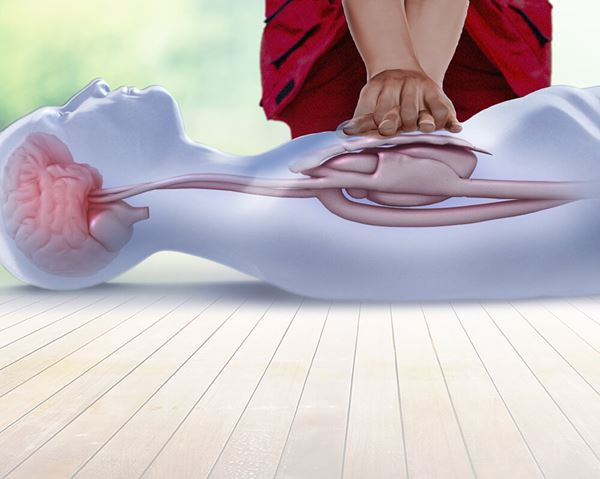
CPR – or Cardiopulmonary Resuscitation – is an emergency lifesaving procedure performed when the heart stops beating. Immediate CPR can double or triple chances of survival after cardiac arrest.
The American Heart Association invites you to share our vision: a world where no one dies from cardiac arrest. Every year, 350,000 people die from cardiac arrest in the United States. Big number. Bigger opportunity. With your help, we can bring that number down to zero.
Why Is CPR Important?
Chain of Survival
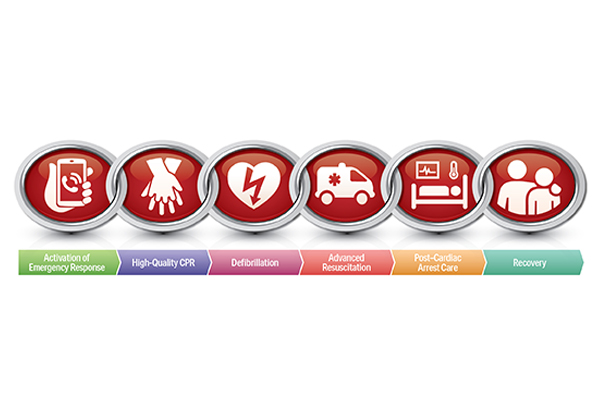
The 6 links in the adult out-of-hospital Chain of Survival are:
- Recognition of cardiac arrest and activation of the emergency response system (calling 9-1-1 in the US)
- Early CPR with an emphasis on chest compressions
- Rapid defibrillation
- Advanced resuscitation by Emergency Medical Services and other healthcare providers
- Post-cardiac arrest care
- Recovery (including additional treatment, observation, rehabilitation, and psychological support)
A strong Chain of Survival can improve chances of survival and recovery for victims of cardiac arrest.
Automated External Defibrillators (AED)
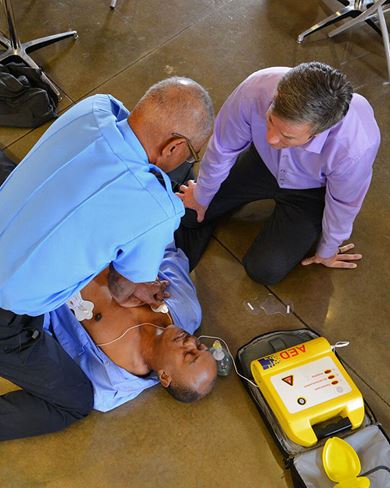
AEDs can greatly increase a cardiac arrest victim's chances of survival. The AHA offers a two-page guide on how to implement an AED program at a company or organization. To minimize the time to defibrillation for cardiac arrest victims, deployment of AEDs should not be limited to only trained people (although training is still recommended).How is CPR Performed?
There are two commonly known versions of CPR:
- For healthcare providers and those trained: conventional CPR using chest compressions and mouth-to-mouth breathing at a ratio of 30:2 compressions-to-breaths. In adult victims of cardiac arrest, it is reasonable for rescuers to perform chest compressions at a rate of 100 to 120/min and to a depth of at least 2 inches (5 cm) for an average adult, while avoiding excessive chest compression depths (greater than 2.4 inches [6 cm]).
- For the general public or bystanders who witness an adult suddenly collapse: compression-only CPR, or Hands-Only CPR. Hands-Only CPR is CPR without mouth-to-mouth breaths. It is recommended for use by people who see a teen or adult suddenly collapse in an out-of-hospital setting (such as at home, at work, or in a park).
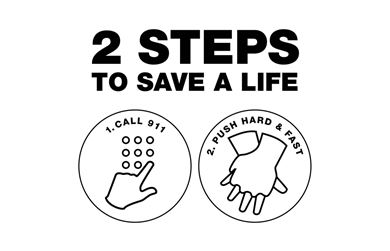
Hands-Only CPR consists of two easy steps:
- Call 9-1-1 (or send someone to do that)
- Push hard and fast in the center of the chest
About High-Quality CPR
- Minimize interruptions in chest compressions
- Provide compressions of adequate rate and depth
- Avoid leaning on the victim between compressions
- Ensure proper hand placement
- Avoid excessive ventilation
Even Children Can Perform Successful CPR

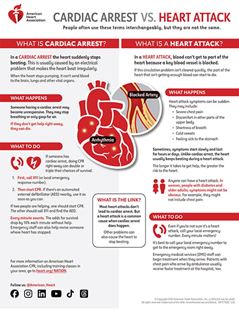
What is Cardiac Arrest?
Occurs when the heart malfunctions and stops beating unexpectedly.
Cardiac arrest is an “ELECTRICAL” problem.
What is a Heart Attack?
Occurs when blood flow to the heart is blocked.
A heart attack is a “CIRCULATION” problem.
Find a Course Near You
